Looking Back at Yamaha’s Lineup 20 Years Ago in 2003 Share
Let’s take a look at the bikes from 20 years ago in a poster!

At YSP Oita, there is an old store that used to operate as “YSP South Oita,” and there was an interesting poster there. The photo above is that poster, and according to the timestamp, it’s from 2003. YSP Oita moved to its current location (along the Medical University Bypass) in 2004.
This was the year that Valentino Rossi, who retired last year, first joined Yamaha. The poster is from just before that time. Since it’s now 2023, this is exactly 20 years ago. There are already many bikes that make us feel nostalgic!

Looking back, what a diverse lineup it was at that time. Air-cooled 4-cylinder engines like the XJR series were common back then. For people of a certain age who are looking for a bike, there must be many who say they wanted something like this!

Large scooters were also very popular at that time. It was an era when customizations were done on models like the Majesty C. There were speakers, decorative lights, and so on. At our store, we had work like this almost every day. Now, customized scooters have almost disappeared, but back then, they were firmly established as a genre of bikes. One of the reasons why they gradually disappeared is that big scooters take up space, so it became inconvenient when parking restrictions for bikes were enforced.
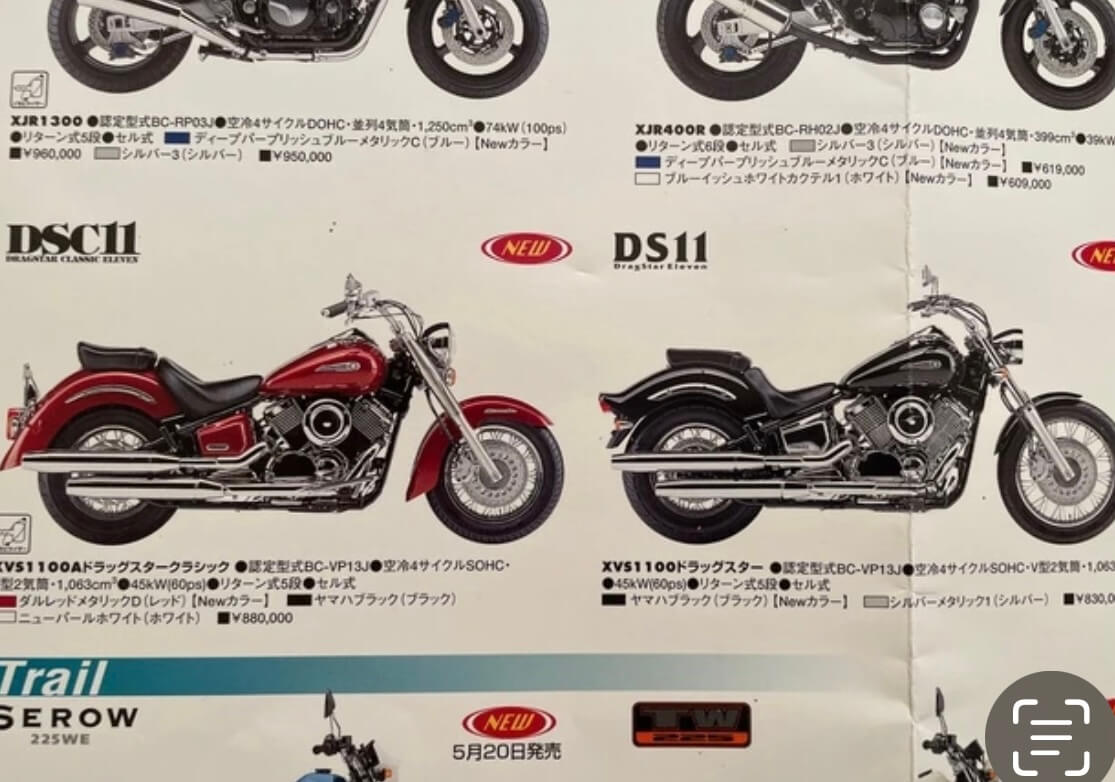
The DragStar has now disappeared, but at that time, it was a popular model that no one thought would ever go away. Below are the DragStar 1100 and Classic 1100.

The 400 was a popular model.

And the 250. There was a wide range of classes. I still think they would sell if they were available now…

This year, it has been decided that the BOLT will be discontinued (although there is still stock at the moment). There are almost no more American-style bikes with genuine V-twin engines. Compared to today’s prices, emission controls, and ABS requirements, these bikes seem more affordable. And then there’s the SR400, which was still carbureted at the time (it switched to fuel injection in 2010).

The price was 460,000 yen, 90,000 yen cheaper than now (even before considering that the SR has disappeared…). The off-road models were the Serow 225 and TW225, priced at 389,000 yen and 339,000 yen, respectively. These were affordable price ranges, and many people used them as commuter vehicles.
The Serow became a 250 the following year, and production ended the year before last. The TW ended production in 2007. There was a time when it was a huge boom, but now we don’t see them much anymore. However, if they existed at these prices today, I think there would be a lot more motorcycle riders.

The 50cc moped class was also well-stocked.

Scooters were popular, but manual transmission bikes were also available back then. Many people started with this class and then stepped up to larger displacement bikes. The high-powered, 2-stroke RZ50 and the YB-1, which was inspired by the design of the SR, were attractive in retrospect. Yamaha’s business bike “Mate” series, now a thing of the past, was a work vehicle.

Honda had the Cub, while Yamaha had the Mate, which was also a 2-stroke (except for the Town Mate). The number of people who use motorcycles for work has decreased significantly, but they were still part of the lineup at that time. They were sturdy, lightweight, and convenient for Japanese people as a means of transportation.
Looking back, all of them were attractive, and the prices were affordable. Except for some models, there were hardly any safety features like ABS back then. Looking at it now, it even makes you wonder if we really need all those features.
Is it just me who feels that the more the motorcycle side focuses on safety, the worse the riders become? However, it’s amazing how much has changed in just under 20 years. I can understand why someone who hasn’t visited a motorcycle shop in a while would feel like “Urashima Taro” (a character from a Japanese folk tale who experiences time travel).
On the other hand, it shows that motorcycles have been exposed to waves of harsh changes over the past decade or so. And more drastic changes are waiting in the future. The cost of producing a single bike and allowing it to run on public roads will increase even more, which will probably be reflected in the price. Even though some bikes will survive amidst regulations, others will disappear and never be seen again.
You can see this just by looking at the poster above. If you already have a bike, it’s essential to maintain it properly and pass it on to the next generation. Parts won’t be sold forever, but securing them and having regular inspections and maintenance can prevent significant breakdowns. In a 10-year time frame, we don’t even know if gasoline engines will exist. We are already seeing signs of electrification. If there is a current model you want now, it might be your last chance to get it.